


Most of us have a company we wish we had invested in sooner.
Maybe we bought its products for years before thinking about buying the stock. Maybe we watched it become a household name and assumed we had already missed our chance. Eventually, after another strong earnings report or another conversation about how well the business is doing, we start paying closer attention.
The case for owning it seems pretty straightforward. Customers love it. Sales are growing. The company has an advantage that competitors are struggling to match.
Those are all good reasons to take an interest. But there’s another question that deserves just as much attention.
How much are you paying for all of that?
We ask that question almost automatically when buying a house or a car. We can love the property and still walk away because the asking price is too high. With stocks, a rising price can have the opposite effect. It attracts attention, builds confidence, and makes us more eager to buy.
Meanwhile, the business may need to accomplish more and more just to justify what investors are already paying for it.
A lot of success can already be included
When you buy a stock, you’re purchasing a small ownership stake in a business. What that stake is worth depends in large part on the profits the company can generate over time. Investors make judgments about those future profits, and their expectations help determine what they’re willing to pay today.
That leaves plenty of room for disagreement. One investor might expect steady growth for the next five years. Another might believe the company is just getting started and will dominate its industry for decades. The second investor will probably be willing to pay a much higher price.
Both could agree that the company is excellent. They could even be right about its future. Their investment results could still look very different because they paid different amounts to participate in that success.
This is where a convincing investment story can get us into trouble. Once we become confident in the business, it’s easy to give the purchase price less attention than it deserves. We start thinking about everything the company could accomplish without asking how much of that success the stock price already assumes.
Howard Marks, cofounder of Oaktree Capital Management, has made this distinction a recurring theme in his writing. The quality of an investment depends on the relationship between what you pay and what you receive. Even an outstanding business can become an unattractive purchase when expectations push its price too far.
A company can keep growing while the investment takes years to catch up to the price you paid.
Microsoft
Consider Microsoft in 2000.
Over the following decade, its annual revenue grew from about $23 billion to more than $62 billion. Annual profits nearly doubled, rising from roughly $9.4 billion to $18.8 billion. There were setbacks along the way, but Microsoft finished the period generating substantially more revenue and profit than it had at the beginning.
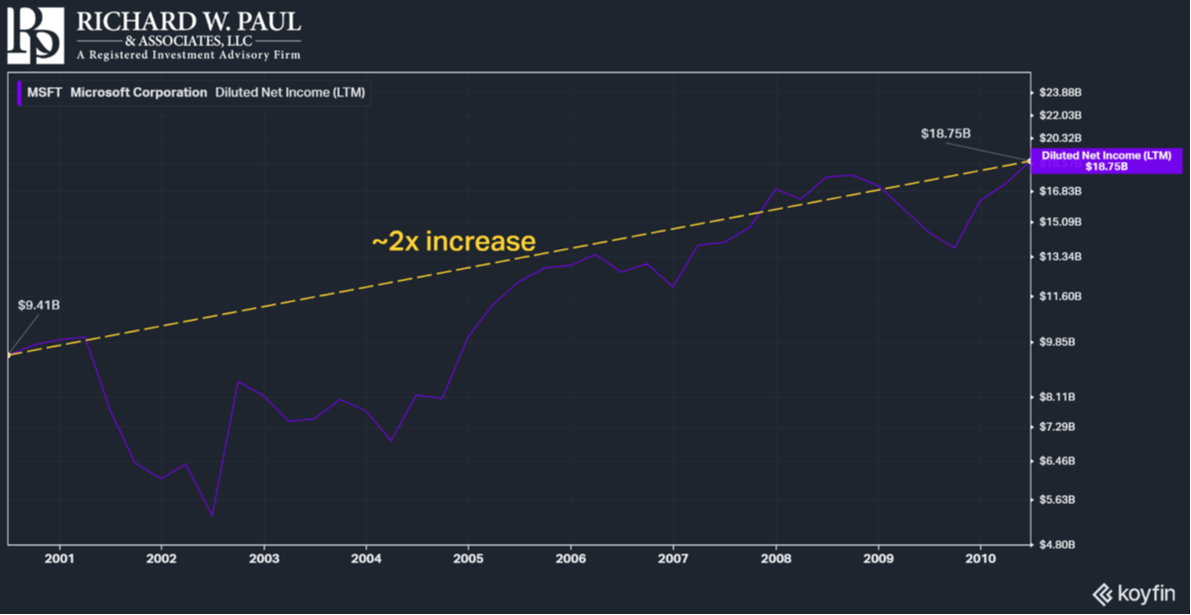
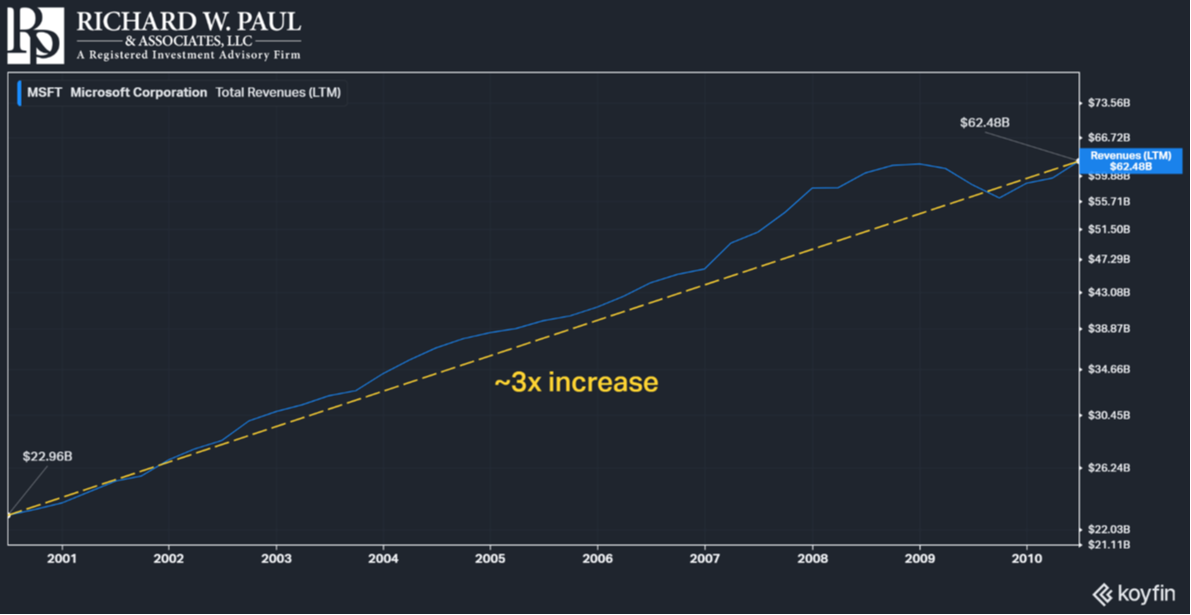
If someone had told you those numbers in advance, buying the stock might have sounded like an easy decision.
Yet an investor’s total return over the same period tells a different story.
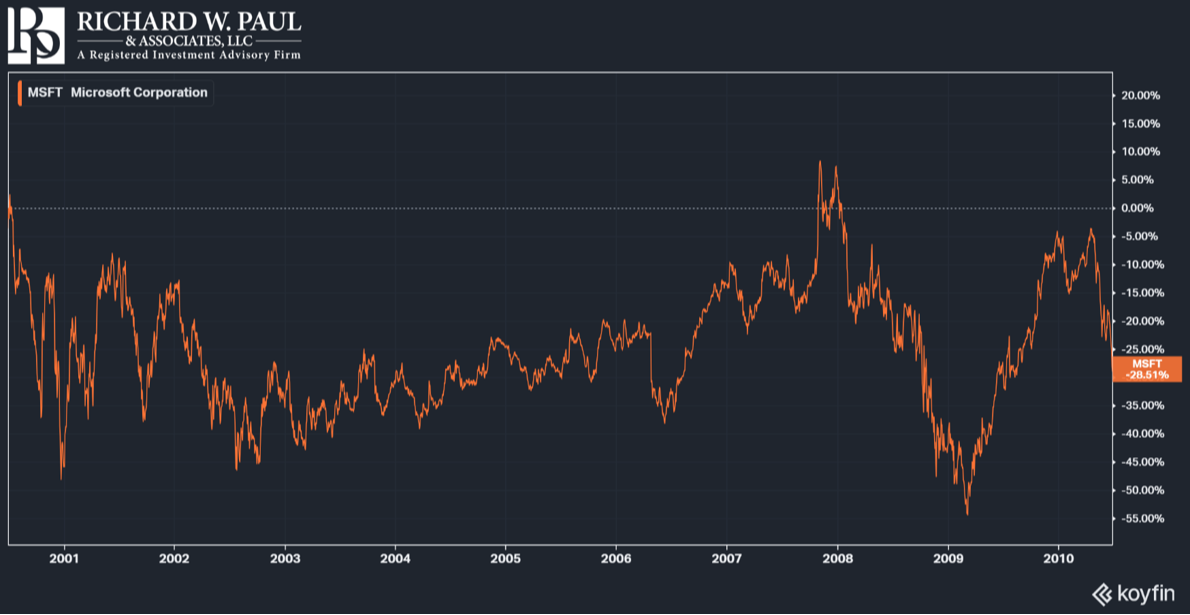
Microsoft delivered substantial growth over those ten years. Why wasn’t that enough for shareholders?
What were investors paying for?
Microsoft’s stock price already reflected enormous confidence in its future. Investors were paying a premium for the growth they expected, leaving a high bar for the company to clear. As profits grew over the following decade, investors became willing to pay less for each dollar of those earnings, offsetting the company’s progress.
Scott McNealy, then the CEO of Sun Microsystems, offered a blunt explanation of that kind of optimism. Looking back at his own company’s valuation during the dot-com boom, he told BusinessWeek in 2002 that investors had been paying ten times annual revenue.
“At 10 times revenues, to give you a 10-year payback, I have to pay you 100% of revenues for 10 straight years in dividends,” he said.
That would leave nothing to pay employees, build products, fund research, or cover taxes. Every dollar coming through the door would have to go straight to shareholders just to return their purchase price over a decade.
His question to investors was simple. “What were you thinking?”
You can see how investors get there. A company has a promising future, and people become willing to pay more to participate in it. Eventually, the price can require years of exceptional results just to support what buyers have already paid. By then, even substantial growth may leave shareholders disappointed.
How much has to go right?
When you’re excited about a company, it’s easy to spend most of your time thinking about what could go well. A new product could take off. The business could expand overseas. Competitors might struggle to catch up.
Those possibilities deserve consideration. So does a less exciting question.
What happens if the company does well, but falls short of the future investors are already paying for?
Maybe sales grow at a healthy pace instead of an extraordinary one. Maybe competitors force the company to lower prices. Maybe expansion takes longer or costs more than expected. None of those developments necessarily means the business is in trouble. They can still make an ambitious valuation harder to justify.
That’s why we think an investment decision should leave room for ordinary disappointments, often described as a margin of safety. If the price only makes sense when you assume rapid growth, strong profits, and very little competition for years to come, there may not be much room for things to go differently. That’s what we mean when we describe a stock as “priced to perfection.” The business may be excellent, but the valuation leaves little room for it to be anything less.
These are some of the questions we work through when evaluating an investment. They’re also worth asking before you buy a stock on your own. How much growth does the price appear to assume? How long does it need to last? What could get in the way?
You won’t be able to answer every question precisely. The exercise can still reveal whether you’ve built a reasonable case for the investment or simply become comfortable with a compelling story.
Admiring from a distance
A great business deserves your attention. It doesn’t require your investment at every price.
There’s no requirement to own every successful company. The goal is to find investments where the price, the prospects, and the risks make sense together.
Sometimes the growth prospects justify paying a premium. Sometimes the expectations leave too little room for disappointment. And sometimes you simply can’t make a confident enough judgment to commit your money. You’re allowed to admire from a distance.
-
Disclosures
This material has been prepared for informational purposes only and should not be construed as a solicitation to effect, or attempt to effect, either transactions in securities or the rendering of personalized investment advice. This material is not intended to provide, and should not be relied on for tax, legal, investment, accounting, or other financial advice. You should consult your own tax, legal, financial, and accounting advisors before engaging in any transaction. Asset allocation and diversification do not guarantee a profit or protect against a loss. All references to potential future developments or outcomes are strictly the views and opinions of Richard W. Paul & Associates and in no way promise, guarantee, or seek to predict with any certainty what may or may not occur in various economies and investment markets. Past performance is not necessarily indicative of future performance.