


Another presidential election. Another new tax plan. Headlines drown investors. Panic ensues.
It’s the same story. Every. Single. Time.
Taxes do matter. Almost 70% of U.S. economic activity comes from consumer spending. Add in business spending, and it’s 88% of our $29 trillion economy1. When money is taken out of the pockets of consumers and corporations, it’s cash that won’t get spent in the economy.
But let’s think about what it takes to change the tax code. To start, the party campaigning change must win, and if we’ve learned anything about elections this millennium, polling voters is as informative as analyzing winning roulette numbers on those electronic boards.
Next, that party must win the Senate and the House of Representatives. Otherwise, we’ll see gridlock for the next two years. As an aside, markets love gridlock because nothing gets done, and that’s predictable.
Then, Congress must agree. Most tax policy passes through the Senate via “budget reconciliation,” a fast-track process for considering bills. Instead of the traditional 60-vote minimum, a reconciliation bill only needs a simple majority2.
Most of what’s been proposed so far from both candidates qualifies for reconciliation, but even a simple majority is asking a lot from politicians. Just ask Biden how his administration fared not too long ago, thanks to just two dissenting senators.
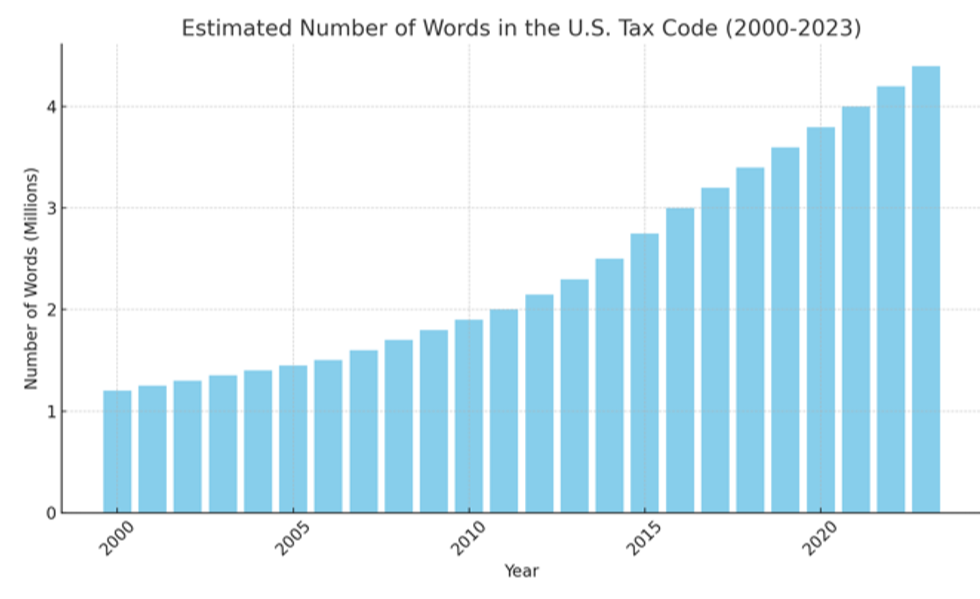
Simply put, Congress is called the “promise filter” for a reason. Politics move at warp speed because promises are just words, while policy moves at a snail’s pace due to endless red tape and checks and balances. These are features of our government, not bugs, and the chart below suggests that it may only get harder to make changes to the tax code over time3.
But what if?
For the sake of argument, let’s assume a “blue wave” and all Democrats in Congress align. Kamala Harris wants to raise taxes, so how likely is the successful implementation of what’s being promised on her campaign trail? Let’s break apart her tax plan into three buckets: (1) been there, done that, (2) difficult but not impossible, and (3) no shot.
In the “been there, done that” bucket, throw in raising the corporate tax rate to 28% and returning the income tax on top earners to 39.5%. Annoying to some but not world-ending. The corporate tax rate was way higher than 28% for Obama’s entire presidential term, yet the S&P 500 tripled. The income tax on top earners was 39.5% from Clinton to Trump, but that didn’t stop the entrepreneurship that fueled the internet revolution, fracking, and cancer immunotherapy.
The standout in the “difficult but not impossible” bucket is adjusting the long-term capital gains tax rate from 20% to 28%. Along with an increase in the “net investment income tax” in the Affordable Care Act, the top capital gains rate would rise to 33%, the highest since 1978.
Even if senators facing a tough reelection in 2026 were willing to risk their jobs for this one, the public backlash might grow as the country realizes the potential impact. Jimmy Carter tried to raise this tax, but the backlash was so fierce that he was forced to relent and cut the tax instead4.
The “no shot” bucket is exclusively reserved for taxing unrealized gains over $100 million. Pushing aside the fact that this would kneecap the Democrat’s largest donor base in Silicon Valley, this has never been done before for a good reason.
The IRS would have to determine how to value assets that don’t trade in markets or lack comps. Given that it took the IRS over 12 years and millions in legal fees to assess the value of Michael Jackson’s estate, I’m not sure how they expect to do the same for tens of thousands of assets yearly.
The bottom line
Assessing the potential future of tax policy isn’t all that different than any other challenge when building a financial plan. The best we can do is think through all the possible outcomes, estimate the odds of each happening, and then quantify the impact. Having invested through several presidential elections, I’ll do my best Yogi Berra impersonation and summarize this time as “déjà vu all over again.” Higher taxes will slow economic growth, but they won’t stop it.
The bottom line is that wherever you stand politically, take it to the voting booth and exercise your right as an American. But keep politics out of your portfolios because investments have done just fine under all sorts of tax regimes, and there’s little reason to suggest that will change anytime soon.
Sources
1 The Federal Reserve. As of 9/30/2024
2 https://budget.house.gov/publications/fact-sheet/budget-reconciliation-basics
3 The data provided is based on estimates and projections from various studies and historical references about the U.S. tax code. A few notable sources that have tracked the growth of the tax code over time include:
**National Taxpayer Advocate Reports** – These reports, published annually by the IRS, often discuss the complexity of the tax code and provide insights into its expansion.
**Congressional Research Service (CRS)** – The CRS produces reports that analyze changes in the tax code and offer estimates of its size and complexity.
**Tax Foundation** – A think tank that often publishes research on U.S. tax policy and tracks the growth of the tax code.
**Public Administration and Legal Studies** – Various academic papers and articles have estimated word counts of the tax code and its growth.
Since no official, exact word count is published annually, the data represents an estimated trend based on public and private analyses over the years.
4 https://www.wsj.com/articles/SB120536977668532201
Disclosures
This material has been prepared for informational purposes only and should not be construed as a solicitation to effect, or attempt to effect, either transactions in securities or the rendering of personalized investment advice. This material is not intended to provide, and should not be relied on for tax, legal, investment, accounting, or other financial advice. You should consult your own tax, legal, financial, and accounting advisors before engaging in any transaction. Asset allocation and diversification do not guarantee a profit or protect against a loss. All references to potential future developments or outcomes are strictly the views and opinions of Richard W. Paul & Associates and in no way promise, guarantee, or seek to predict with any certainty what may or may not occur in various economies and investment markets. Past performance is not necessarily indicative of future performance.