


A government shutdown is one of those political events that seems abstract—until it isn’t. When Congress fails to approve funding for federal agencies, daily life in the U.S. can face real, if temporary, disruptions. Many people wonder what a government shutdown means and who’s affected most. Let’s explore the realities of shutdowns in a way that feels more like a conversation than a list.
The whole process begins with Congress and the annual requirement to pass a dozen appropriations bills that fund different parts of the federal government. If lawmakers don’t reach a consensus, non-essential agencies and operations come to a halt, while essential services—like air traffic control, in-hospital medical care, and border protection—keep running. These disruptions aren’t just theoretical; they impact everything from the operations of national parks to the processing of passports.[1]
History gives us some perspective. Since the budget process began in 1976, there have been more than 20 shutdowns, though only a handful have lasted beyond a few days. The most notable was the 35-day shutdown in late 2018 and early 2019, which left parts of the government frozen for more than a month. That standoff wasn’t just political drama—it delayed paychecks for hundreds of thousands of federal workers and stalled vital services. Most federal employees who are furloughed during these episodes ultimately receive back pay, but the financial and emotional toll during the wait can be considerable.[2]
Financial markets generally don’t flinch much at government shutdowns. Although uncertainty may trigger short-term volatility, history shows that shutdowns are usually short-lived and their long-term effect on stock returns tends to be minor. Looking at the chart below, on average, the S&P 500 has historically been about flat during shutdowns, with a slightly higher probability of gains vs. losses since 1976. Considering that most of the losses came during the late 1970s, and the biggest decline during a shutdown since 1980 was 2.2%, history suggests stocks have a good chance of going higher during this shutdown, though past performance does not guarantee future results.
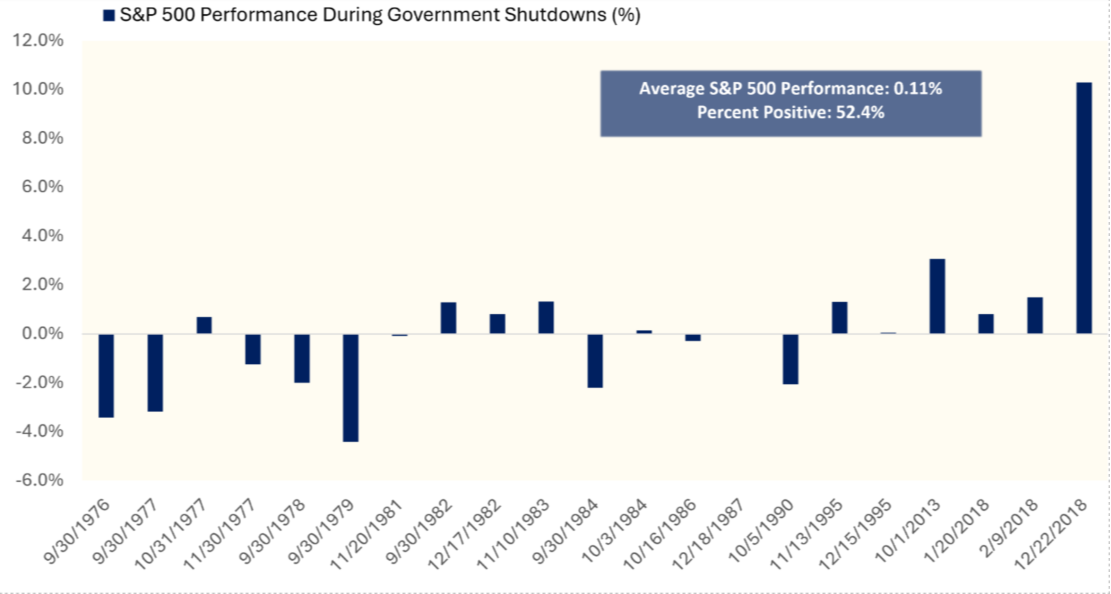
Source: LPL Research, Bloomberg, Strategas Research 09/30/25
Though financial markets tend to hold up, there are still costs. The government incurs billions in lost productivity, delayed transactions, and penalty fees. For the broader economy, shutdowns can stall private-sector investments or disrupt hiring, as businesses may not be able to get federal permits or approvals they need, even as essential programs like Social Security and Medicare continue without a hitch.
Shutdowns don’t save taxpayer money, contrary to some assumptions. The interruption in services, combined with the requirement to provide back pay to furloughed employees, means the federal government actually ends up spending more. For example, the 34-day partial shutdown in 2018-19 cost the U.S. economy more than $11 billion, some of which was never recovered.[2]
The path to avoiding shutdowns is clear in theory: Congress needs to pass either all appropriations bills on time or a temporary funding measure known as a continuing resolution. Yet, political disagreements over spending priorities often disrupt this process.
While government shutdowns might seem routine at this point, each episode brings its own unique challenges for federal employees, businesses, and the public. Understanding these complexities helps make sense of the headlines—and serves as a reminder that beneath the political theatrics, very real lives and services are affected.
Sources:
- https://usafacts.org/articles/everything-you-need-to-know-about-a-government-shutdown/
- https://www.crfb.org/papers/government-shutdowns-qa-everything-you-should-know
- https://www.morningstar.com/news/marketwatch/20251001200/why-investors-dont-need-to-play-defense-during-the-government-shutdown-even-if-it-lasts
Disclosures
This material has been prepared for informational purposes only and should not be construed as a solicitation to effect, or attempt to effect, either transactions in securities or the rendering of personalized investment advice. This material is not intended to provide, and should not be relied on for tax, legal, investment, accounting, or other financial advice. You should consult your own tax, legal, financial, and accounting advisors before engaging in any transaction. Asset allocation and diversification do not guarantee a profit or protect against a loss. All references to potential future developments or outcomes are strictly the views and opinions of Richard W. Paul & Associates and in no way promise, guarantee, or seek to predict with any certainty what may or may not occur in various economies and investment markets. Past performance is not necessarily indicative of future performance.