


The question keeps coming in. Is the AI trade in the toilet?
I land in the same place I did in July. Yes and no. The buildout has not been repealed. The spending is still enormous, revenue is still growing, the contracts still run for years, and the technology keeps moving faster than the skeptics expected. What changed is where the pain showed up, and why a lower stock price is not the same thing as a better investment.
Picture a whip, because the picture does the sorting for you. A small flick at the handle becomes a crack at the tip. Near the handle sit the companies that already make money and can fund most of what they want to build. Nvidia, Microsoft, Alphabet, Amazon, Meta, and TSMC, the manufacturer behind the most advanced chips. They can have a bad month, or a bad week, like the one we just saw as several reported their capital spending at earnings. But out at the tip sit the speculative names, including businesses that used to mine bitcoin and now want to rent out AI computing. A bad month out there can leave a 30% or 50% hole, even when the customers haven't gone anywhere.
The week of October 12 was a bad week for the tip. It started with the lenders, and the lenders had been trying to tell us something for months.
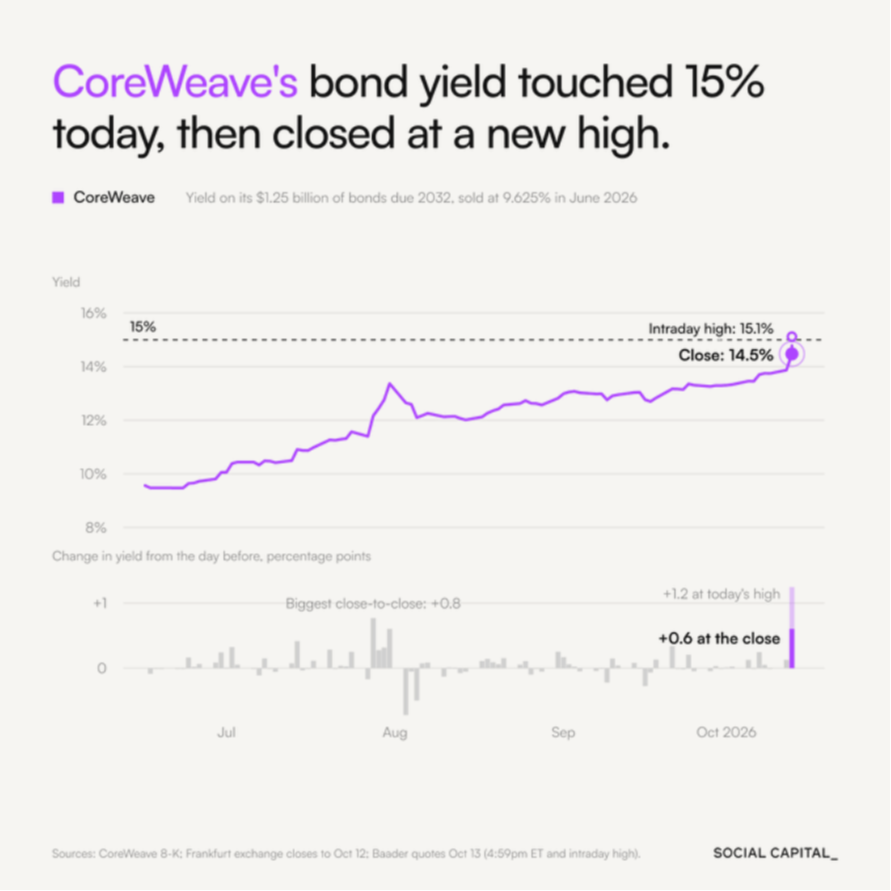
CoreWeave rents out the specialized computers that run AI models. Its customers want more of those computers than the company can build with its own cash, so it has borrowed about $50 billion to grow. Look at the chart of one of its bonds. In June, lenders wanted roughly 9.6% a year to hold it. By early October, before anything "happened," they wanted about 14%. That climb took four months. The stock market caught up in about four days.
That's the part of this story I'd tape to the fridge. Bondholders get paid before stockholders and have less upside, so they tend to worry earlier and more quietly. When a company's cost of borrowing keeps creeping up while its stock shrugs, one of those two groups is wrong. This time it was the stock.
A few dominos led to this mini correction. Fresh inflation data came in a bit hot, prompting traders to bet that interest rates might move higher. Companies that borrow the most feel that before anyone else does. Then the chart started making the rounds, and Elon Musk answered it with one word…

On Tuesday, one of those bonds traded at a level that paid the buyer about 15% a year. That is expensive money. Lenders charge it when they're worried about being paid back on schedule, or at all. Some of CoreWeave's loans are backed by the chips themselves, so those lenders at least have equipment to point to. The bonds without that protection are the ones investors dumped.
Wednesday the stock fell 15.5%. It had company. Nebius, another AI computing landlord, fell 11%. Oracle fell 9%. Several former bitcoin miners now pitching themselves as data-center operators fell more than 10% the same day. The selling didn't stop Wednesday. By Friday, CoreWeave was down nearly 25% for the week, its worst week in over 11 months, and one of its bonds had briefly yielded above 16%.
The quarterly earnings numbers explain why the bond chart mattered so much. In the second quarter, revenue more than doubled to $2.58 billion. The company lost $626 million. Interest expense was $640 million, more than twice the year before. Read those last two numbers again. Before paying its lenders, the business was roughly breaking even. The interest bill was the loss. Sales can be booming and the whole plan can still hinge on the next lender saying yes, at a price the business can afford.
CoreWeave's answer is its customer list, and it's a serious answer. At the end of June, customers had committed to $104.2 billion of future revenue, with more than $25 billion of additional commitments signed early in the third quarter. Nvidia's CEO said CoreWeave's financial strength improves every day and that Nvidia doesn't need to step in and guarantee the company. He may be right about the demand. The lenders may also be right to charge up for the risk. A full order book does not pay next year's interest on its own. Treat this as a lens on risk, not a recommendation to buy or sell CoreWeave, Oracle, or any other name in this note.
Oracle is the example I care about most, because it ruins the cartoon version of this story. This isn't a tiny company with a shiny slide deck. It's a large, profitable software business most of you already know. It still got caught in the same bad day, because it has borrowed heavily to build AI capacity and traders decided the borrowing was the headline. A company can deserve a spot near the handle and still get whipped like the tip once its balance sheet starts doing the talking.
Korea was the same lesson in different clothes. In the last post, Samsung and SK Hynix took huge one-day losses even though the businesses kept delivering. Ordinary investors had bought them with borrowed money, and falling prices forced more selling. The whip hit the holders. This time it hit companies that had borrowed to build. Needing fresh money at the exact moment lenders get nervous turns a loss of confidence into a problem with the business plan, not just a red number on a screen.
That's the trap I most want you to avoid. A stock that has fallen a lot looks like it's on sale. Sometimes it is. Sometimes you're catching a falling knife.
On that Wednesday, CoreWeave sat about 56% below its 52-week high of roughly $150. Round the math so you can feel it. A $100 stock that falls 56% is a $44 stock. Getting back to $100 means gaining $56 on a $44 price, which is about a 127% return. Breaking even takes more than a double. The decline is where the homework starts, not where it ends.
Three questions do more work than the percentage.
Does this business make money today, or does it need a steady supply of other people's money to keep building?
Can it still build what the stock price assumes while lenders stay picky for a year?
Would the company still matter in a world where AI spending paused?
The third one is the Toto test. Toto was exceptional at ceramics for decades before the chip industry ever showed up as a customer. The AI rush was new demand for an old skill. A tip name whose whole case rests on data centers expanding at this pace forever, with cheap debt the whole way, is a forecast with a loan attached. Forecasts can pay off. They just don't belong in the part of a portfolio that has to fund a retirement.
That's why the core of RWP portfolios sits near the handle. Those businesses can benefit as AI keeps growing, and they have profits to lean on when spending slows or lenders get stingy. We still look at more speculative names when the evidence and the price line up. We just size them so a 50% or 60% drop is unpleasant and not life-changing. A single holding that could move your retirement date, or cost you sleep, by falling that far is already too big.
I don't think the broader AI trade is over. I do think the tip just got a bill from the lenders, and they'd been mailing reminders since June. The bill was 15% and up.
Disclosures
This material has been prepared for informational purposes only and should not be construed as a solicitation to effect, or attempt to effect, either transactions in securities or the rendering of personalized investment advice. This material is not intended to provide, and should not be relied on for tax, legal, investment, accounting, or other financial advice. You should consult your own tax, legal, financial, and accounting advisors before engaging in any transaction. Asset allocation and diversification do not guarantee a profit or protect against a loss. All references to potential future developments or outcomes are strictly the views and opinions of Richard W. Paul & Associates and in no way promise, guarantee, or seek to predict with any certainty what may or may not occur in various economies and investment markets. Past performance is not necessarily indicative of future performance.