


The stock market rebounded nicely this month, erasing all losses from April and recording another all-time high. But some believe the bulls could be at risk as we enter the dreaded summer season for stocks. As the saying goes, “Sell in May and go away.”
Someone, somewhere long ago, coined this phrase, referring to the theory that investors can do better by selling stocks in May and buying back in November. Why, you ask?
It’s hard to say, but the predominant theory is somewhat anticlimactic. Professional investors are just like us. They work hard and need time off to recharge. They typically travel during summer, so there tends to be less trading volume.
But if the A-Team is on vacation, that leaves the B-Team and possibly even the C-Team to cover large trading desks. These cohorts may not be as active for fear of screwing up, drying up even more liquidity. Less experienced traders also tend to panic more if/when this drop-off in liquidity leads to increased volatility.
Before making rash decisions, let’s examine the data to see if they support this proverbial warning. The chart below depicts simulated results for three strategies from 1871 through 20211.
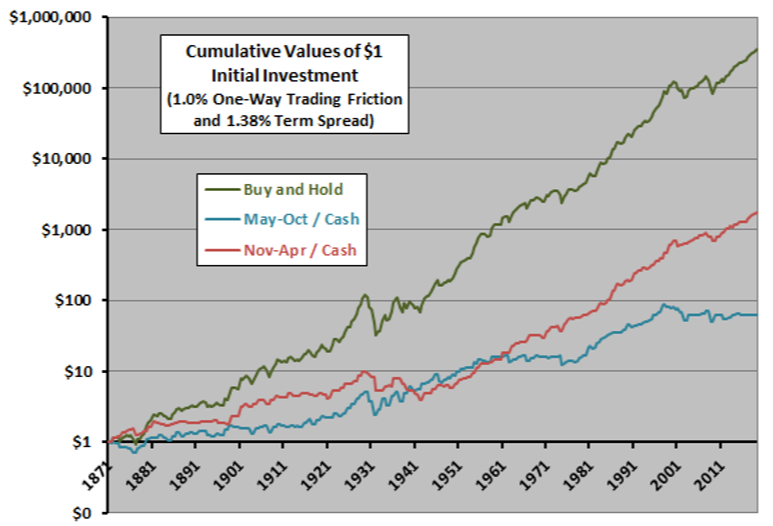
Selling in May and buying back in November (red line) would have taken $1 and turned it into $1,697. The opposite, selling in November and buying back in May, did much worse (blue line). This only returned $92. Therefore, the adage appears to hold some merit.
However, the green line shows the performance of a buy-and-hold strategy. The return on a $1 investment grows to around $500,000, over 280 times larger than the red line.
The whole point behind a short-term trading strategy is to outperform a buy-and-hold one to justify the trading costs and taxes paid. This data, albeit back-tested and full of assumptions, suggests investors should think twice before using a calendar to trade stocks.
The bottom line
Think about what it took to fix a car in the 1980s versus today. Back then, a wrench and a basic understanding of an engine could fix most problems. Today, consumers practically need an engineering degree to fill tires with air. The sophistication has turned cars into computers on wheels, and financial markets have evolved similarly. Consider the following:
Depth: Satellites capture high-resolution pictures of parking lots, shipyards, farmland, etc. Computers then analyze these images to count cars in parking lots, ships in port, and corn stalks being harvested to spot trends before the media can report anything official.
Latency: Speed is so critical that it motivated Spread Networks to spend over $300 million to lay 825 miles of straight-line optical fiber to shave off three milliseconds (three-millionths of one second) of communication time between the futures markets in Chicago to the stock markets in New York2. For scale, the blink of a human eye takes around 400 milliseconds, but in high-frequency trading, three milliseconds is an eternity.
Mind Reading: Natural Language Processing (NLP) is a technology that trains computers to analyze and derive meaning from human language in a useful way. It uses Artificial Intelligence (AI) to examine patterns in data to improve a program's ability. NLP is regularly used in trading strategies that run autonomously across global markets 24/7.
For example, when the Federal Reserve releases minutes from its most recent meeting, a computer can read the entire statement, calculate the mood and tone of the author by the grammar and punctuation used, and then trade stocks based on an algorithm’s assessment of where the Fed’s monetary policy is heading. This is all done in the time it takes a mere mortal to click on the link to read the press release.
Back when we could fix our cars, only the military used satellites, the World Wide Web was science fiction, and programmers used floppy disks and played Pong.
Professional investors on Wall Street have also changed. Old-school traders have been replaced with MBAs and PhDs from some of the most prestigious academic institutions in the world, and these traders don’t use wrenches.
Lastly, while these tools may sound cutting-edge and a byproduct of the recent rise in AI, it all happened over a decade ago (Spread Networks went live in 2010 and was acquired in 2017). Nothing above is even remotely new. Just imagine how today’s AI and other burgeoning tech are being used to inform trading strategies.
Here's a fun example. Neuroforecasting is a new field that examines brain activity to improve investment decisions. In a study published last month, professional investors’ brains were scanned while they researched stocks to see if their nucleus accumbens, the part of the brain that subconsciously processes anticipation of reward, activated when their sub-conscience found attractive stocks3.
The researchers found that the investors’ conscience decisions were no better than a coin toss. However, their sub-conscience decisions, measured by the degree of activation in this part of the brain, were far more accurate, at 68%. That’s a staggering number (I’ve never met anyone who has been right 2/3rd of the time in this business).
If these data hold, guess how quickly hedge funds will try to corner the market for MRI machines. They’ll have every trader, research analyst, and portfolio manager working in one of those tubes for 15 hours a day because that’s what it takes to get an edge when your performance is being measured monthly.
The bottom line is that today’s stock market consists of artificial intelligence on top of wires that transfer data close to the speed of light and being driven by some of the smartest people alive. It is highly unlikely that a trading strategy predicated upon selling around Memorial Day and buying back after Halloween could consistently outperform. Therefore, stick to a long-term plan based on fundamentals rather than a short-term one that rhymes.
Sources
1 https://www.cxoadvisory.com/calendar-effects/sell-in-may-over-the-long-run/
3 https://www.wsj.com/finance/investing/what-our-brains-know-about-stocksbut-wont-tell-us-880d5d72
Disclosures
This material has been prepared for informational purposes only and should not be construed as a solicitation to effect, or attempt to effect, either transactions in securities or the rendering of personalized investment advice. This material is not intended to provide, and should not be relied on for tax, legal, investment, accounting, or other financial advice. You should consult your own tax, legal, financial, and accounting advisors before engaging in any transaction. Asset allocation and diversification do not guarantee a profit or protect against a loss. All references to potential future developments or outcomes are strictly the views and opinions of Richard W. Paul & Associates and in no way promise, guarantee, or seek to predict with any certainty what may or may not occur in various economies and investment markets. Past performance is not necessarily indicative of future performance.