


If you’re heading into retirement with both meaningful guaranteed income and a seven‑figure portfolio, you’re not the “average” retiree—your challenges are different. You’ve already done the hard part with decades of saving, staying employed through recessions, and making consistently good financial choices.
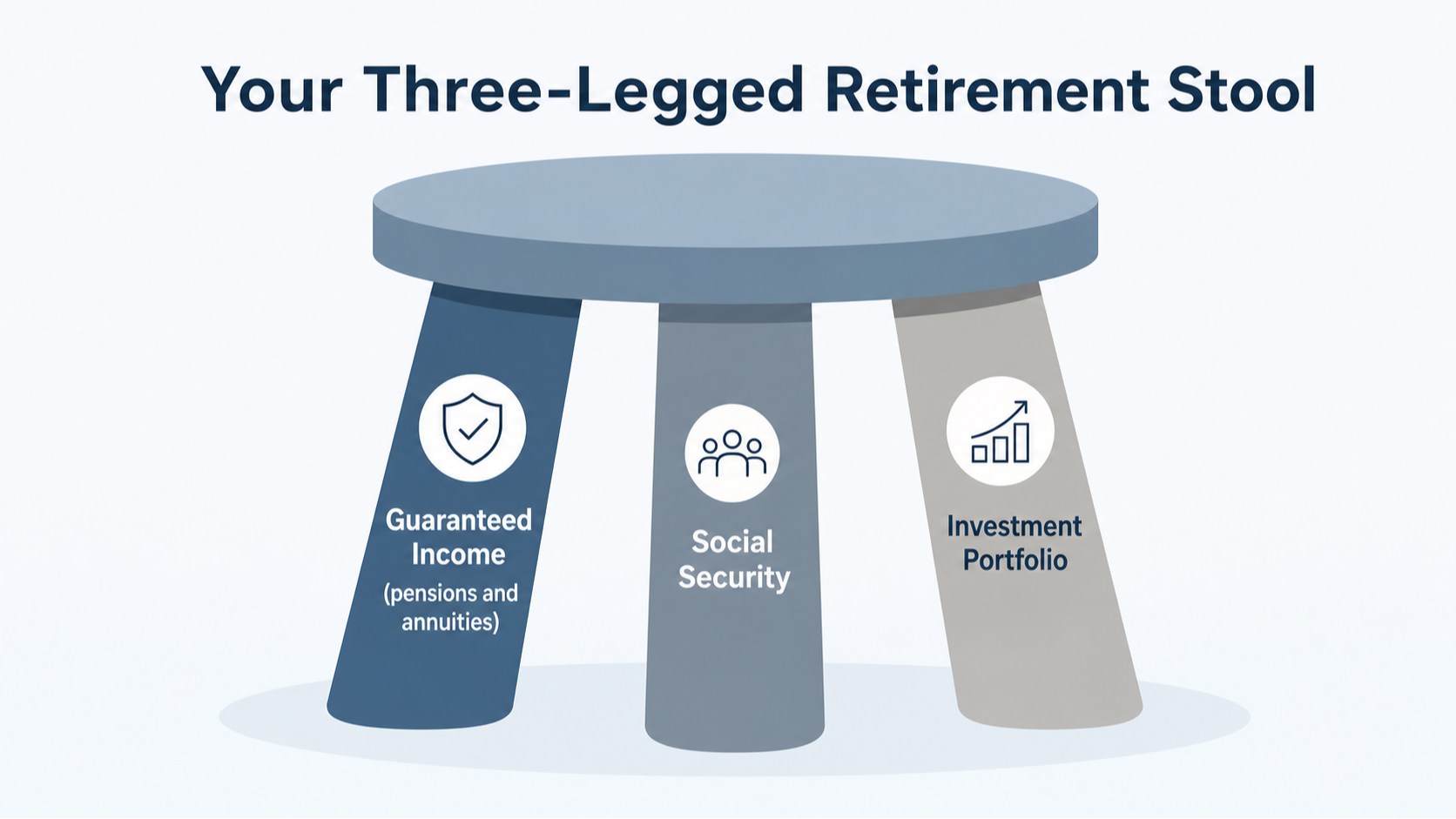
In fact, you have something many retirees don’t anymore which is a true “three‑legged stool” of retirement income. There’s guaranteed income providing predictable cash flow (whether from a traditional pension or annuities), Social Security as a second leg, and a substantial investment portfolio as the third. On paper, that combination should create a high level of security.
Yet when we sit down with people in this position, a surprising pattern shows up: they’re still worried about running out of money, still second-guessing every big purchase, and still pushing back their retirement date “just to be safe.” On paper they’re in the top few percent of retirees; emotionally they often feel like they’re one bad market away from disaster.
That disconnect is what we call the 2% Problem.A small slice of retirees who technically have more than enough, but struggle to turn financial security into real-world freedom.
What a 2% Retiree Actually Looks Like
A typical “2%” household has three components working together:
Guaranteed income from a pension or annuities you’ve structured.
Social Security benefits for one or both spouses.
A seven‑figure investment portfolio in 401(k)s, IRAs, and taxable accounts.
In practice, that often means your essential lifestyle is largely covered before you touch a dollar of your portfolio. A typical year might look something like this: guaranteed income and Social Security fund the base, while planned withdrawals from your portfolio sit on top for flexibility like travel, home projects, gifts, and tax‑planning moves.
The key is your portfolio is not the only thing standing between you and running out of money. It’s one pillar of a broader structure, which is why the usual “am I going to run out?” fear often doesn’t match the actual math.
Why Doesn’t It Feel Safe?
On paper, many 2% households are in great shape, but emotionally, it doesn’t always feel that way. The challenge isn’t just numbers; it’s shifting from a lifetime of saving to actually using what you’ve built.
Studies and industry surveys show that a lot of retirees, including affluent ones, spend less than they safely could because they’re afraid of running out of money, facing big healthcare bills, or getting hit by a market downturn at the wrong time. Even people who describe themselves as “comfortable” or “better off than most” report high anxiety about overspending early in retirement.
For most of the 2% group, three forces are doing the heavy lifting:
You’ve had decades of “don’t touch the principal” drilled into you, so withdrawals feel wrong even when the plan assumes them.
You’re constantly reminded of worst‑case scenarios like market crashes, inflation, and long‑term care, so every extra trip or project feels like a risk.
You see yourself as the financial safety net for your family, which makes it easier to say no to yourself than to say yes.
In other words, if you’ve ever looked at your accounts and thought, “I know we’re okay, but I still don’t feel okay,” you’re not broken or alone, you’re reacting exactly the way decades of conditioning would predict.
The Pitfalls
Alongside the emotional side, there are a few very real technical issues that can trip up 2% retirees if they don’t plan for them.
The Retirement Tax “Arc”
Your tax picture often starts out mild and then ramps up:
Early retirement (especially before Social Security) can mean relatively low taxable income.
As guaranteed income, Social Security, and required minimum distributions (RMDs) stack up, your marginal tax rate can jump later in life.
Without planning, you can end up paying more tax over your lifetime than necessary and feel locked into conservative spending later. This is where Roth conversions in your lower income years, thoughtful Social Security timing, and asset location can make a meaningful difference.
The Widow’s Penalty
When one spouse dies, the surviving spouse often keeps most of the income but moves from married filing jointly to single brackets. That can mean higher tax rates on similar income, especially once RMDs and survivor benefits are in the mix.
If pension or guaranteed income survivor choices were optimized only for the highest monthly payment today, the survivor can later be squeezed by lower income and higher taxes. Planning ahead by factoring survivor cash flows, choosing survivor options deliberately, and using Roth and beneficiary strategies can help protect the spouse who lives longer.
Treating Each Piece in a Silo
Finally, many retirees mentally separate guaranteed income, Social Security, and investments. They “live on the guaranteed stuff” and try never to touch the portfolio, even though the whole system was built to work together.
The 2% opportunity is to integrate those pieces: let the guarantees cover the floor, use the portfolio for lifestyle and tax strategy, and invest according to your true risk capacity rather than pure fear.
A Simple Framework: Floor, Lifestyle, Legacy
Once you see the emotional and technical pitfalls, the question becomes: how do we make this feel safe and structured instead of vague?
We like to organize a 2% retiree’s plan into three buckets:
Floor: Your Safety Net
This is the part of your plan that should feel boring and reliable.
We define your non‑negotiable expenses: housing, food, insurance, basic transportation, healthcare.
Then we line those up against your guaranteed income and Social Security, and decide how much, if any, needs to be backed up by very conservative assets.
When your floor is clearly mapped and tested against “what if” scenarios, it gets easier to see that a market swing or a vacation is not going to change whether you can keep the lights on.
Lifestyle: Spending Without Guilt
This is where the 2% Problem shows up most.
We set a realistic annual lifestyle number for travel, hobbies, home projects, family experiencesand run it through conservative market return assumptionsand long‑life scenarios.
If the plan holds up, that number becomes your “permission slip” to actually use your money, not just look at it.
Having a target, and a plan that backs it up, is what turns “I think we’re okay” into “Iknow we’re okay to do this.”
Legacy: Impact on Your Terms
Finally, we get clear about what you want your money to do beyond your own lifestyle.
How much do you want to pass to kids, grandkids, or causesand how much of that should happen now versus later?
Which accounts are best for which goals (pre‑tax, Roth, taxable), and how do we coordinate beneficiary and estate planning so the money goes where you intend?
Every dollar you’ve saved will eventually support your lifestyle, support someone else, or go to taxes. Being explicit about how much you want in each column is what turns a generic retirement into your retirement.
Bottom Line
If you’re in the 2%with real guaranteed income, Social Security, and a sizable portfolio, your biggest risk often isn’t running out of money. It’s getting to the later years of your life realizing you never fully used the security you spent decades building.
The tension you feel is normal.You were trained to protect principal, brace for the unknown, and look out for everyone else. The way through is not another rule of thumb or magic withdrawal rate.It’s a plan that clearly separates your floor, your lifestyle, and your legacy, and shows you what each one can truly support.
When you can see, in black and white, that your essentials are covered, your lifestyle is sustainable, and your legacy is intentional, the 2% Problem fades away. What’s left is the real work of retirement which is deciding how you actually want to live with the time and resources you’ve earned.
Disclosures
This material has been prepared for informational purposes only and should not be construed as a solicitation to effect, or attempt to effect, either transactions in securities or the rendering of personalized investment advice. This material is not intended to provide, and should not be relied on for tax, legal, investment, accounting, or other financial advice. You should consult your own tax, legal, financial, and accounting advisors before engaging in any transaction. Asset allocation and diversification do not guarantee a profit or protect against a loss. All references to potential future developments or outcomes are strictly the views and opinions of Richard W. Paul & Associates and in no way promise, guarantee, or seek to predict with any certainty what may or may not occur in various economies and investment markets. Past performance is not necessarily indicative of future performance.