


Bonds have had another rough year, and the Fed's recent rate hike put yields back on the move. It's come up in enough client conversations lately that it's worth writing down where we stand: bonds have been painful to hold, but we're not giving up on them.
The short version is that the same rate increases that have hurt bond prices have also made bonds pay more. To explain why that matters, it helps to back up and look at how we got here.
How We Got Here
Rates were unusually low for most of the years after the financial crisis. The Fed held its benchmark near zero for years, cut it back to zero again in 2020, and bonds issued during those stretches paid next to nothing for it. When inflation showed up and the Fed started raising rates in 2022, those old, low-paying bonds got repriced hard.
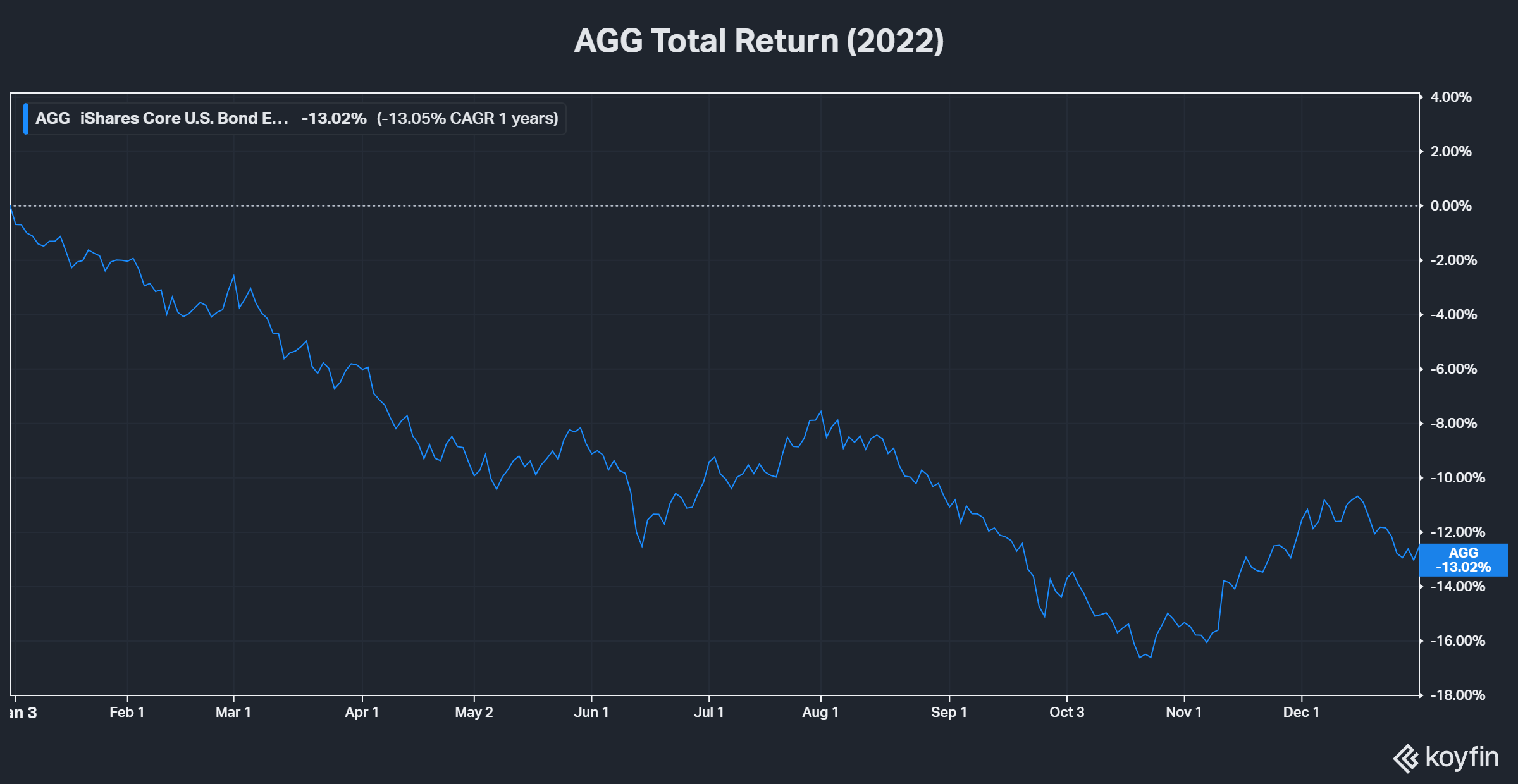
You can see it in the chart below. AGG, a widely held bond fund, fell roughly 13% that year, the worst calendar year on record for the benchmark it tracks. That's a rough one for money that's supposed to be the steady part of a portfolio.
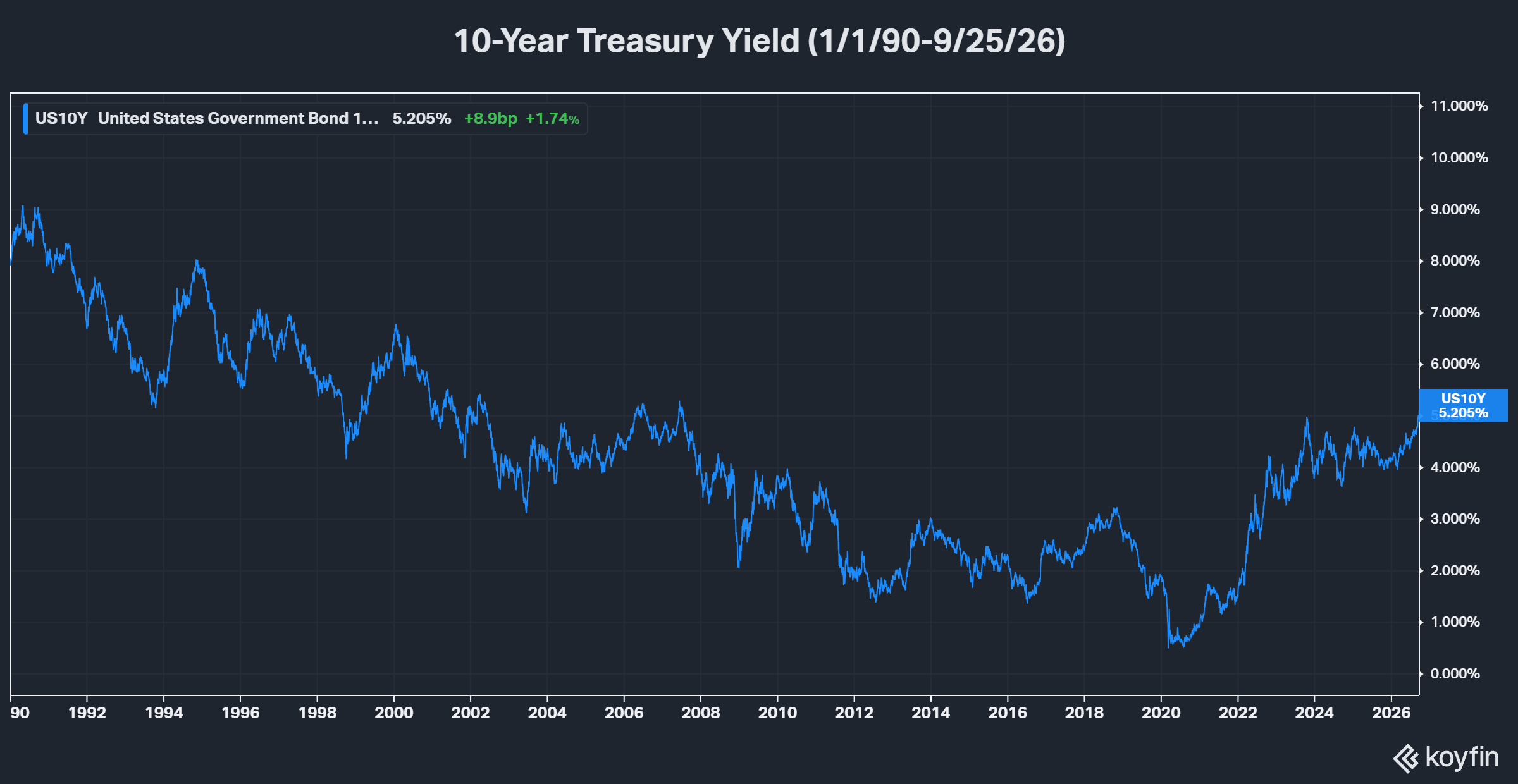
The longer view helps put today’s yields in context. Look at the 1990s: 10-year Treasury yields were higher then than they are now. What felt normal to a lot of investors was really the 2010s and the 2020-2021 stretch, when yields sat near zero for years. Today's 5% doesn't look so alarming once you see the full picture. It hurt the bonds we already owned, but it's also made new bonds pay a lot better.
Bond Math
Here's the part that gets lost when everyone's staring at price: a bond keeps paying interest no matter what its price does day-to-day. At today's yields, that interest can do real work for someone drawing income from a portfolio.
The yield you start with also tells you a lot about what you're likely to earn. Buy a bond at 5% and hold it to maturity, and assuming the issuer pays as promised, you know what you signed up for. A bond fund is a little messier, since it's constantly buying and selling, but the logic holds. Higher yields mean more income coming in the door to reinvest.
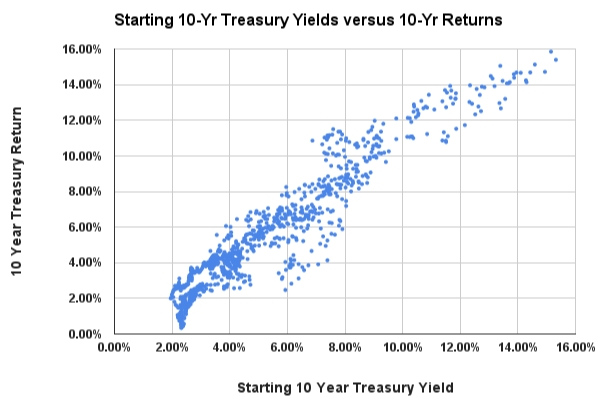
The chart below shows this isn't just theory. Each dot plots the yield available on the 10-year Treasury at a point in time against what it returned over the following 10 years. Start with a higher yield, and you tended to earn more over the next ten years. There are exceptions, and nobody can promise the next ten years will look like the last few decades. But we'd rather be starting from here than from the near-zero yields of a few years ago.
Bond prices could still fall if rates keep climbing, and we wouldn't be surprised to see more of that. But we're getting paid more to wait, and that's a big part of why we're comfortable holding bonds right now. It's also part of why we think the pain bonds have been through is closer to an opportunity than a reason to bail on the asset class.
Blood in the Streets
There's an old line about buying when there's blood in the streets. People usually say it about stocks, but it applies just as well to bonds. After one of the worst stretches bond investors have ever sat through, it's fair to wonder whether it's time to walk away. We think that selloff is exactly why yields are worth locking in now, even knowing prices could dip further from here.
The obvious pushback is that the Fed isn't done hiking. Maybe not. Its latest projections point to one more increase this year. But watch how fast those projections move. Fed officials pegged the year-end 2026 rate at 3.8% back in June. By September, that number was 4.1%. Just a few weeks before the September meeting, most economists surveyed expected the Fed to sit still. It hiked anyway.
The dot plot is worth glancing at, but we wouldn't build a portfolio around it. It's a snapshot of where officials think rates should go based on what they know right now, and the Fed's own numbers show how wide the historical margin of error has been. Inflation surprises, the dots move. We'd rather own bonds at today's yields than try to out-guess the next meeting.
If Stocks Take a Hit
There's one more reason we hold bonds: they can be useful exactly when everything else in a portfolio is getting hit. When investors get nervous about a recession, money tends to flow into Treasuries, pushing yields down and prices up. The Fed also tends to cut rates fast in that kind of environment.
Go back to the Treasury chart and look at the plunge around the COVID panic. Rates fell off a cliff as the Fed made two emergency cuts within weeks, taking its benchmark back near zero. Anyone who'd already dumped their bonds because yields looked too skimpy missed out on exactly the protection bonds are supposed to provide.
That protection isn't automatic. 2022 is the counterexample: inflation was the problem, not growth, and bonds fell right alongside stocks because yields were starting from almost nothing. Today’s rate environment is different. Yields are meaningfully higher, which gives the Fed real room to cut if the economy stumbles. That's exactly the setup where bonds could cushion a stock selloff instead of adding to it. Nothing here is guaranteed, but it's a real reason to want bonds around, especially if you’re relying on your portfolio for income in retirement.
Bottom Line
Bonds have been frustrating, and we're not pretending otherwise. But the same rate moves that hurt prices have pushed yields to levels we haven't seen in years, and that changes the math going forward. We're holding onto bonds because of what they can pay from here, and because they still have a job to do if the economy hits a rough patch. We don't need to call the Fed's next move correctly for that to be true.
-
Disclosures
This material has been prepared for informational purposes only and should not be construed as a solicitation to effect, or attempt to effect, either transactions in securities or the rendering of personalized investment advice. This material is not intended to provide, and should not be relied on for tax, legal, investment, accounting, or other financial advice. You should consult your own tax, legal, financial, and accounting advisors before engaging in any transaction. Asset allocation and diversification do not guarantee a profit or protect against a loss. All references to potential future developments or outcomes are strictly the views and opinions of Richard W. Paul & Associates and in no way promise, guarantee, or seek to predict with any certainty what may or may not occur in various economies and investment markets. Past performance is not necessarily indicative of future performance.